Coloring Pages for Seniors and People With Dementia: What Works, What to Avoid
Large print and bold lines, yes — but also adult subjects, familiar themes, good contrast and the right grip. What caregivers and activity coordinators find works for older adults and people living with dementia, and the common mistakes that make coloring feel childish.
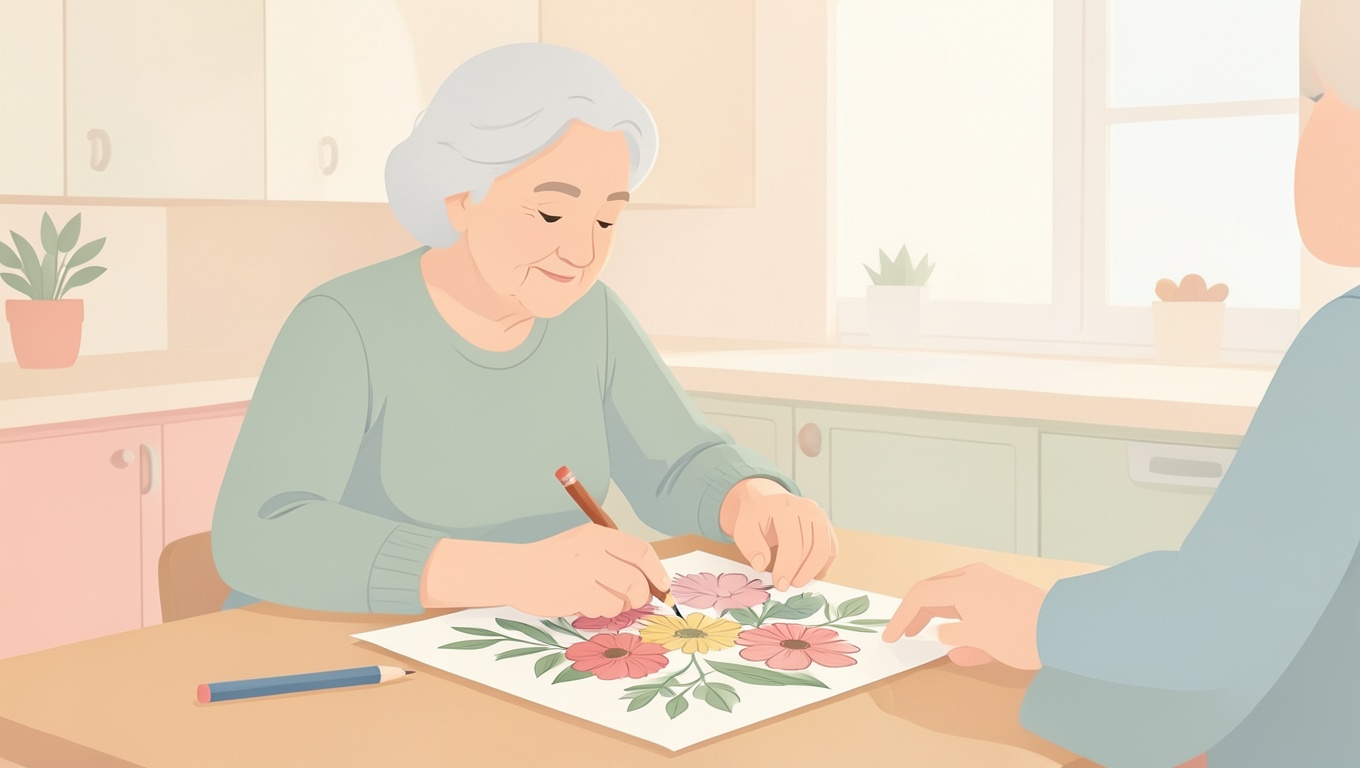
Short answer: coloring works well for many older adults — including many people living with dementia — when the pages are adult in subject (flowers, gardens, birds, landscapes, vintage objects, familiar scenes), printed large with bold, clear outlines, high in contrast and low in clutter, and when the tools are easy to hold and the session is short, social and pressure-free. The two most common mistakes are handing over children’s pages, which feels patronizing, and handing over intricate “adult coloring book” pages, which are too fine for tired eyes and stiff hands. The sweet spot is in between, and it’s easy to hit once you know what to look for.
Why coloring suits this age group
It needs no instruction, no prior skill and no ability to follow multi-step directions. It gives the hands a gentle, repetitive task — useful for stiffness and for people who get restless. It creates a natural, low-pressure reason to sit together and talk, which is often the real value. And there is modest research support: a randomized controlled study of community-dwelling older adults in Taiwan found a short mandala-coloring program lowered anxiety and improved mood compared with controls (Koo and colleagues, 2020). Coloring is not a treatment for dementia; it is a good activity, and good activities matter a great deal. For the broader picture of what the studies show and don’t, see does coloring actually help with anxiety?
What makes a page work
1. Adult subjects, familiar themes
Gardens, flowers, birds, butterflies, fruit bowls, teapots, classic cars, sailboats, landscapes, seasonal scenes, patterned quilts, simple mandalas. For someone with dementia, familiarity is the lever: subjects from the person’s life — the kind of flowers they grew, the type of dog they had, the seaside, a church, a kitchen scene — invite recognition and conversation (“we had roses like that”). Cartoon animals, licensed characters and anything obviously from a children’s book are the fastest way to make an adult feel talked down to. If a person genuinely loves cartoons, that’s different — follow the person, not the rule.
2. Large print, bold lines
Outlines should be noticeably thicker than a typical adult coloring book — around 1.5–3 mm (4–8 pt) printed — and the shapes large enough to fill with broad strokes. Print on letter or A4 at full size, never two-per-page. If a page you like has thin lines, print it at 120–150% so the main subject fills the sheet, or thicken the lines in an image editor.
3. High contrast, little clutter
Pure black lines on bright white paper. No grey shading, no texture hatching, no busy backgrounds. One clear subject, maybe a simple frame. Visual clutter is tiring for aging eyes and disorienting for someone with cognitive change; clean pages are easier to “read.”
4. A level of detail matched to the person — and it changes
Someone active and sharp may enjoy a moderately detailed garden scene. Someone in the middle stages of dementia usually does better with one large subject and a handful of big areas. Later on, very simple shapes — one flower, one leaf — and the act of making marks may be what remains enjoyable. Keep a range on hand and quietly swap rather than announcing a “harder” or “easier” page.
5. Paper that feels good and doesn’t slide
A slightly heavier 24–32 lb paper or light cardstock is easier to handle than flimsy copy paper and takes pencil well. A non-slip mat or a clipboard stops the page drifting, which matters for anyone with tremor or reduced grip. See best paper for coloring pages for weights a home printer will feed.
Tools that work for stiff hands and tired eyes
- Thick-barrel or triangular colored pencils are the easiest to hold; pencil grips (the foam or triangular sleeves sold for children) work just as well for adults with arthritis.
- Chunky crayons or gel crayons need little pressure and give bold color.
- Washable markers with a broad tip are great for weak grip and low vision — vivid result, no pressure — but caps are fiddly; a cap-holder or an assistant helps.
- Avoid thin standard pencils that need a precise grip, gel pens that skip under light pressure, and alcohol markers unless the paper is heavy (they bleed and smell).
- Lighting: a bright, warm task lamp from the side does more for participation than any page choice.
Running a session: at home, in a care setting, in a group
- Keep it short and frequent. 15–30 minutes, a few times a week, at a time of day when the person is typically at their best (often late morning).
- Offer two or three pages and let them choose. Choice matters; it restores a little agency. Don’t offer twenty — that’s overwhelming.
- Sit and color alongside rather than supervising. Model, don’t instruct. Conversation about the subject — the flower, the boat — is the point.
- Never correct colors or “mistakes.” A purple sky is a purple sky. Praise the choice, not the accuracy.
- Let them stop when they want. An unfinished page is not a failure; it can come out again tomorrow.
- In groups, seat people where they can see each other’s pages, use a single theme for the table so conversation flows, and have a helper float to re-cap markers and swap pages. Display finished pages — a wall of work is a quiet dignity.
- For people with dementia specifically: reduce the number of colors on the table to five or six, remove everything else from the surface, and be ready for the activity to become about sorting pencils or simply making marks. All of that is fine.
Adapting for specific needs
- Low vision / macular degeneration: even bolder lines (3 mm+), larger shapes, maximum contrast, bright lamp, and markers or crayons that show clearly. Some people do better with a page printed on pale yellow paper to reduce glare.
- Tremor: heavier paper on a clipboard, thick-barrel tools, bigger shapes; a weighted glove or resting the forearm on the table helps some people.
- Arthritis: fat triangular pencils or grip sleeves, frequent short breaks, markers for effort-free color.
- Stroke / one-handed: clip or tape the page down so it doesn’t move; place tools on the working side.
- Hearing loss: coloring is a great low-verbal shared activity — sit on the person’s better side and keep the table quiet.
What to avoid
- Children’s pages for someone who would recognize them as such.
- Intricate, tiny-detail adult pages (the ones that sell best on the shelf are usually the wrong choice here).
- Glossy paper, grey lines, busy backgrounds.
- Turning it into a test of ability or memory (“what color is a banana?”).
- Long sessions that end in tiredness or frustration.
Where to find suitable pages
Search for “large print” and “simple adult” pages and apply the checklist above. On ColorThese, the flower coloring pages and the simpler mandala pages are a good shelf; print at full size and pick the less busy designs. Photographs of the person’s own life — their old house, their garden, a favorite place — turned into bold outlines are uniquely engaging; our guide to turning a photo into a coloring page explains how, and the tip is to simplify hard: one subject, thick lines, no background.
Frequently asked questions
Is coloring good for people with dementia?
For many, yes: it’s calming, gives the hands something to do, and creates a reason to sit and talk. Choose adult, familiar subjects with bold lines; keep sessions short; and don’t correct. It is an activity, not a therapy.
What kind of coloring pages are best for seniors?
Large-print pages with bold outlines, adult subjects (flowers, gardens, birds, landscapes, vintage objects), high contrast, and little clutter. Detail matched to the individual, and changed quietly over time.
Are adult coloring books too detailed for someone with dementia?
Most are. They’re designed for fine pencils and good eyes. Look for “large print” editions or print your own pages at full size with thick lines.
What are the best coloring tools for arthritis?
Thick-barrel or triangular colored pencils, pencil grips, chunky crayons, or broad washable markers — anything that doesn’t need a pinch grip or much pressure.
How often should we do it?
A few times a week for 15–30 minutes tends to work better than occasional long sessions. Follow the person’s energy.
The goal is a calm half hour and a conversation, not a finished masterpiece. If the page gets abandoned halfway and the talk turns to the garden they had in 1972, the session worked.