Coloring Pages for Toddlers: What Makes a Page Age-Appropriate (Line Thickness, Size, Subjects)
Most “toddler” coloring pages are just kids’ pages shrunk down. What actually works for 1–3-year-olds: outline thickness, one big shape, familiar subjects, and a few things to avoid — plus how to make or pick pages that fit.
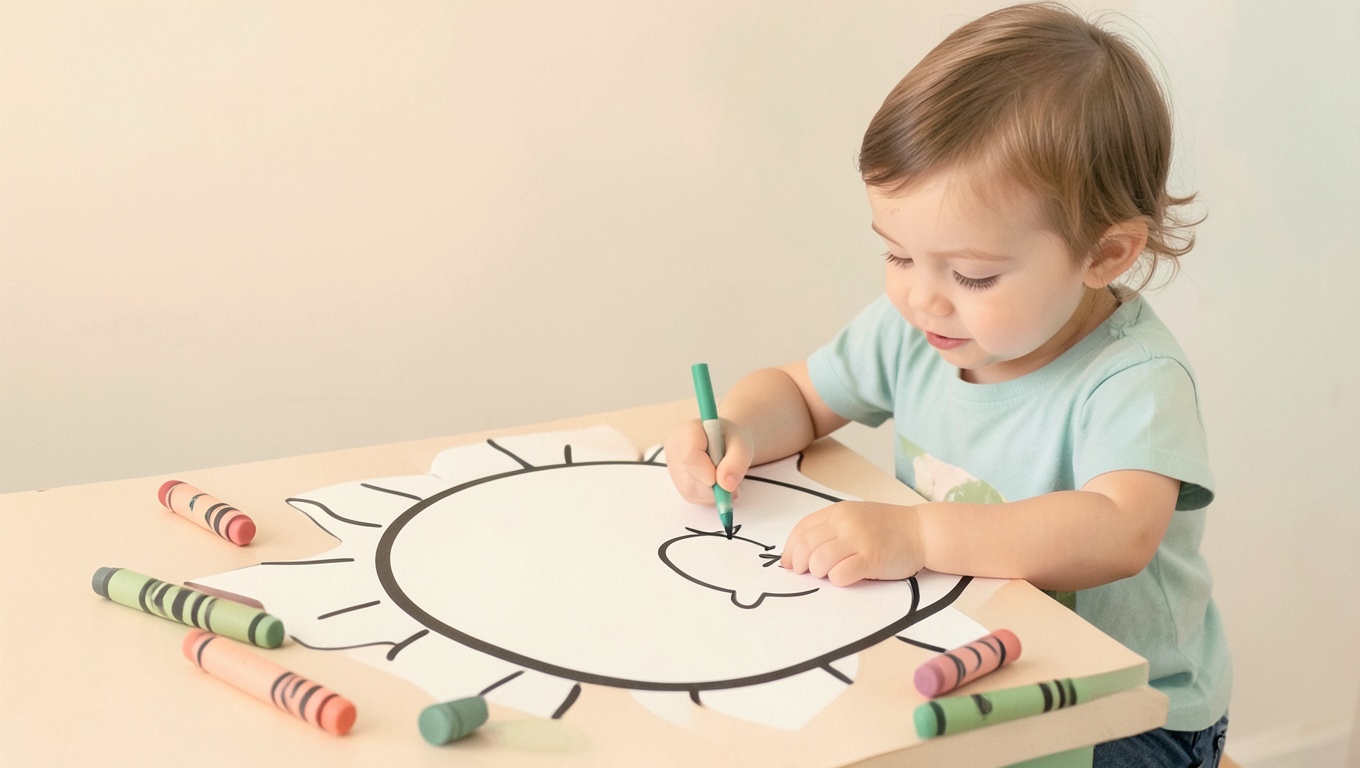
Short answer: a coloring page works for a toddler when it has one big, simple subject (or at most two or three), thick outlines — roughly 5–8 pt at print size, the width of a chunky crayon line — lots of open space inside each shape, no small interior detail, and a subject the child already recognizes. A page that meets those five tests will get used; a beautiful detailed page will get a scribble across the middle and then the back of the sheet. Below: why each rule matters, how to judge a page in five seconds, where to find or how to make pages that fit, and what to expect the result to look like.
Why toddlers need a different page, not a smaller one
A 1–3-year-old holds a crayon in a fist or with fingers pointing down, moves from the shoulder and elbow more than the wrist, and is only just beginning to notice that a shape is a thing you can color in. Their strokes are big and not especially aimed. A page with thin lines and small areas gives them nothing to aim at and no feedback when they hit; one giant shape with a fat outline gives them a clear target and a satisfying “I filled it.” The page is doing the teaching, not you.
The five tests of a toddler-friendly page
1. One big subject
A single apple, a single sun, one fish, one car, one teddy. At most two or three large elements for older toddlers. If you have to point to “the part you color,” it’s too busy.
2. Thick outlines
Aim for lines about as wide as a chunky crayon stroke — printed, that’s roughly 2–3 mm (5–8 pt). Thick lines do two things: they survive a toddler coloring over them, so the picture still reads, and they visually separate the shape from the background so the child can see where to aim. Thin “adult coloring” lines disappear under crayon.
3. Big open areas
The inside of each shape should be large enough to fill with broad strokes — think 5 cm / 2 in and up. Small enclosed areas (eyes, buttons, fingers) are invisible to a toddler and just create visual noise.
4. No interior detail
Texture lines, patterns, backgrounds, grass, clouds behind the subject — strip it all. If the page has a background, it competes with the subject and the child colors the wrong thing or everything at once.
5. Familiar subject
Toddlers engage with what they know: animals they’ve seen, food they eat, vehicles, a ball, a cup, a shoe, a face. Abstract patterns and licensed characters they don’t yet follow don’t hold attention. Photos of their own world turned into simple outlines — their dog, their cup — are the most engaging of all (our guide to turning a photo into a coloring page covers how).
The five-second check
Hold the page at arm’s length and squint. Can you still see the outline clearly? Is there obviously one thing on the page? Could you color the main area with three broad swipes of a crayon? If yes to all three, it’s toddler-ready. If it blurs into grey, it’s for an older child.
What to expect the result to look like
Scribbles. Across the shape, across the lines, off the page. That’s the correct outcome for a one- or two-year-old, and “mostly inside” on a big shape is a fine outcome for a three-year-old. The page is a target and a prop for talk (“you colored the sun yellow!”), not a test. Our coloring skills by age guide walks through what changes each year, so you’re not comparing a two-year-old’s page to a five-year-old’s.
Tools that pair with toddler pages
Chunky, egg, or triangular crayons in a fist grip; washable. Tape the page to the table (or clip it to an easel) so it doesn’t slide — a page that moves is a page that gets abandoned. Print on plain copy paper; toddlers don’t need heavy stock, and a slightly heavier 24 lb sheet just resists tearing a bit better. Markers are optional and messy at this age; see crayons vs colored pencils vs markers for why crayons first.
Where to find pages that pass
Search terms like “simple,” “easy,” “big,” “preschool” and “toddler” get you closer than “kids,” which is a catch-all. Look at the thumbnail and apply the squint test. On ColorThese, the easy coloring pages collection is the best fit; the alphabet pages with a single big letter and one object also work well for the older end of the range, and simple animals like our puppy pages — pick the least detailed ones.
Making your own toddler pages
It’s easy, and it’s the best way to get the subjects your child actually cares about:
- Draw it: a thick black marker on white paper — one big shape, thick outline — then scan or photograph and print. You do not need to be able to draw; a circle with two ears is a bear.
- Trace it: print a photo faintly, lay paper over it on a window, trace just the outline with a fat marker.
- Generate it: if you use an AI coloring page tool, ask for “one large simple [thing], very thick bold outlines, no background, no small details, toddler coloring page.” Check the result with the squint test and regenerate if it came back detailed. Our free generator’s output is clean line art, and the “simple / bold outline” wording matters.
- Thicken an existing page: in any image editor, a “Minimum” or “Dilate” filter, or simply printing at 150% and accepting that part of the page is cropped, makes lines fatter and shapes bigger.
Print at full page size — never two-per-sheet for toddlers; halving the page halves the target.
Themes that work, by rough age
- 12–24 months: one enormous shape — sun, ball, apple, a single balloon, a big fish. Honestly, they’d be as happy with the back of the sheet; the picture is for you.
- 2–3 years: one big animal (cat, dog, duck), one vehicle (car, bus, tractor), a cupcake, a flower with three big petals, a house with one door and one window. Basic shapes and a single letter or number for the older end.
- 3+: two or three elements (a dog and a ball; a tree and a sun), first simple scenes, and the start of “easy” kids’ pages. Our shark and ice cream pages include some simple enough for this stage.
Things to avoid
- Pages with text to trace or “color by number” — meaningless before 3–4.
- Backgrounds of any kind.
- Thin or grey lines (often from a bad scan or a shrunk-down adult page).
- Many small similar objects (“color all the stars”) — fine at 4, overwhelming at 2.
- Glossy or coated paper — crayons skid on it.
Frequently asked questions
What age can a toddler start coloring pages?
From around 12–18 months for scribbling on a page with a big friendly picture; from about 2 they start aiming at the shape. There’s no benefit in waiting, and no point expecting accuracy.
How thick should the lines be on a toddler coloring page?
About the width of a chunky crayon stroke — roughly 2–3 mm at print size. If a crayon line covers the outline completely, it’s too thin.
Should toddler coloring pages have lots of things to color?
No. One subject, maybe two or three large elements for older toddlers. Busy pages lose them.
Are printable coloring pages OK for an 18-month-old?
Yes, printed on plain paper and taped down, with chunky washable crayons and an adult nearby. Treat it as drawing time with a picture on the page, not as coloring practice.
What’s the best paper for toddler coloring?
Ordinary copy paper. Slightly heavier 24 lb paper resists tearing a little better. Save cardstock for pages you want to keep.
If you want the developmental “why” behind all of this, start with coloring skills by age; if you want pages right now, the easy coloring pages are the closest match.